


Blue crabs counted and measured by blue crab biologists during the Winter Dredge Survey in Maryland. Photo by Joe Zimmermann/DNR
The Chesapeake Bay Blue Crab Winter Dredge Survey, a cooperative effort between the Maryland Department of Natural Resources and the Virginia Institute of Marine Science, estimates a total of 349 million blue crabs in the Chesapeake Bay in 2026, a 46% increase over the estimate of 238 million crabs last year.
The survey also estimated 228 million juvenile blue crabs, an increase of 121% from last year. This above-average abundance is a promising result to fisheries biologists, after what had previously been six consecutive years of below-average juvenile recruitment. The total abundance and juvenile abundance were at the highest levels since 2019.
The number of adult male crabs also increased. There are an estimated 37 million adult male blue crabs in the Bay, which is 43% higher than last year.
However, adult female abundance has decreased by 25%, to 81 million crabs, which is above the management threshold but below the target level. In fisheries management, target numbers represent the desired state of a fishery, while thresholds are lower numbers that can trigger a management response.
“It’s very encouraging to see higher levels of blue crabs and juveniles, especially after a few years of lower juvenile recruitment,” Mandy Bromilow, DNR’s blue crab program manager, said. “However, we’ll still have to remain vigilant about the population, given that we have seen declines since 2011.”
The cold winter led to a large amount of overwintering mortality in the Bay’s crabs, especially among adults. About 20% of adult male crabs and 12% of adult female crabs died in the winter, compared to an average of 9% and 7% male and female overwintering mortality from 1996 to 2026. However, blue crabs have rebounded after years of high overwintering mortality, as seen in 2014.
The dredge survey results come as scientists are finalizing the Chesapeake Bay blue crab benchmark stock assessment, a large-scale analysis of the species and factors affecting their population. The draft assessment found that there are more blue crabs than previously estimated in the Bay, but that the crabs face an overall population decrease without a clear cause.
Over the course of the next year, DNR will discuss how to implement the stock assessment results into its management framework, in coordination with the other jurisdictions, watermen, and scientists.
The previous blue crab stock assessment in 2011 and accompanying management decisions helped to bring the Chesapeake’s blue crab population back from more than a decade of low abundance and harvest levels. The current stock assessment will serve as a critical update to that work by ensuring that management targets and thresholds, including sustainable fishing rates, are set appropriately.
The Winter Dredge Survey has been conducted cooperatively by Maryland and Virginia since 1990, and the results are reviewed annually in an effort to have consistent management efforts across the jurisdictions. Throughout the survey, biologists use dredge equipment to capture, measure, record and release blue crabs at 1,500 sites throughout the Chesapeake Bay from December through March. Detailed results are on the DNR website.
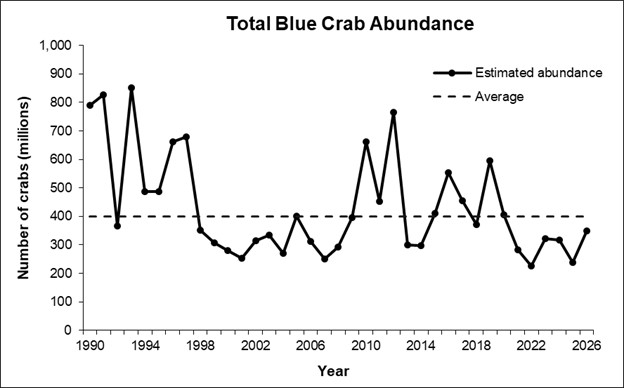
Blue crab abundance in the Chesapeake over time since the winter dredge survey began estimating the population in 1990.

After several years of below-average juvenile abundance, the survey found an increase this year.

The survey found that adult female abundance had decreased, though the population is still above the threshold level for management.
